Gas Laws are one of the most important topics in Thermodynamics and physics. These laws explain how gases behave when pressure, temperature, volume, or amount of gas changes. In these easy study notes, students can quickly learn all major gas laws using formulas, diagrams, memory tricks, and simple examples.
CONTENT INDEX
What Are Gas Laws in Thermodynamics?
Gas Laws describe the relationship between pressure, volume, temperature, and amount of gas. These laws help students understand how gases work in balloons, engines, syringes, refrigerators, scuba tanks, and many real-life systems.
The most important gas laws are:
– Boyle’s Law
– Charles’s Law
– Gay-Lussac’s Law
– Charles’s Law
– Gay-Lussac’s Law
– Avogadro’s Law
– Ideal Gas Law
– Dalton’s Law of Partial Pressure
Boyle’s Law Explained Easy
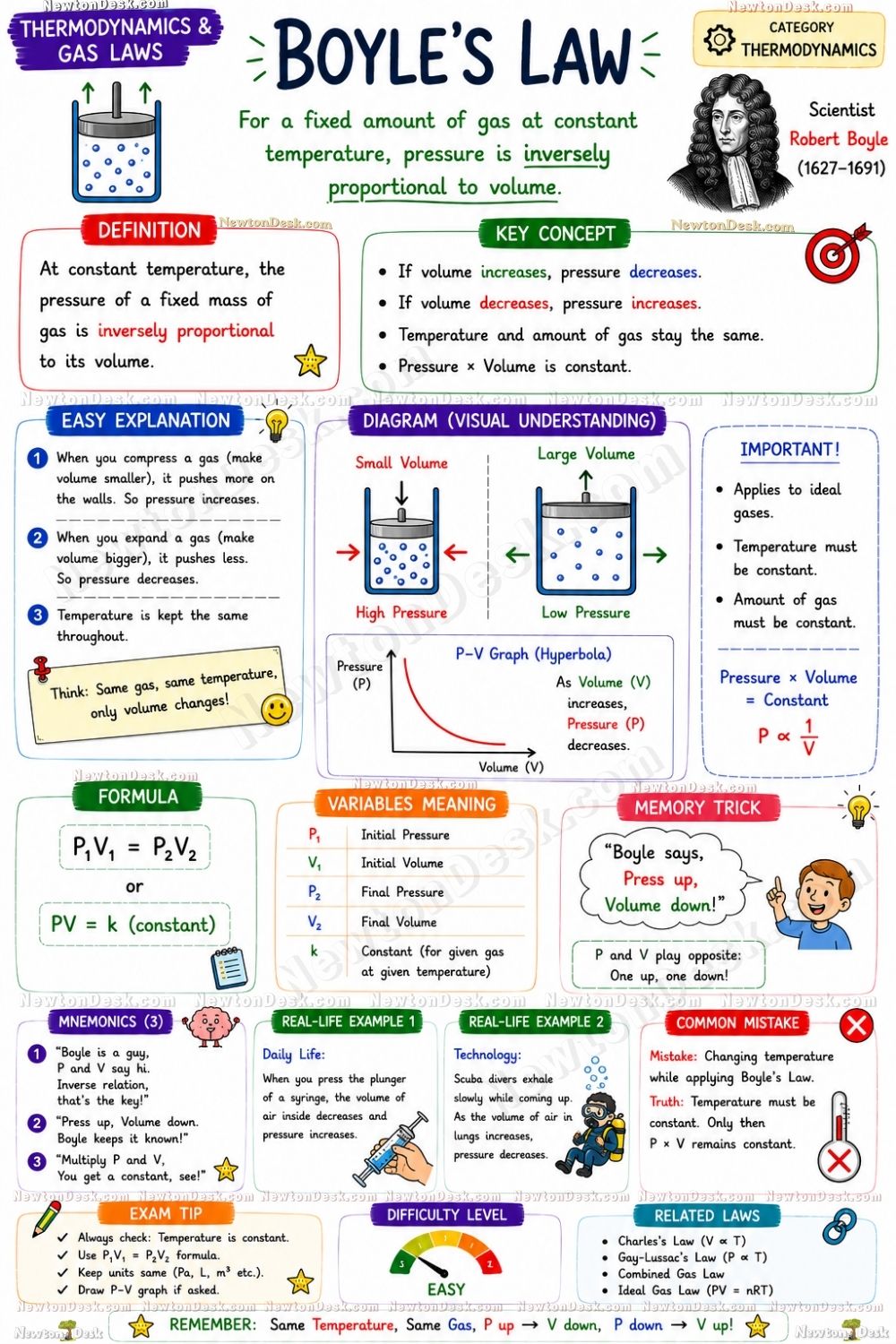
Easy Boyle’s Law notes with formula, graph, examples, and pressure-volume explanation.
Definition of Boyle’s Law
Boyle’s Law states that for a fixed amount of gas at constant temperature, pressure is inversely proportional to volume. This means if volume becomes smaller, pressure becomes higher.
Boyle’s Law Formula
P1/V1 = P2/V2
This law is commonly used in syringes, pumps, and scuba diving systems.
Charles’s Law Explained Simple
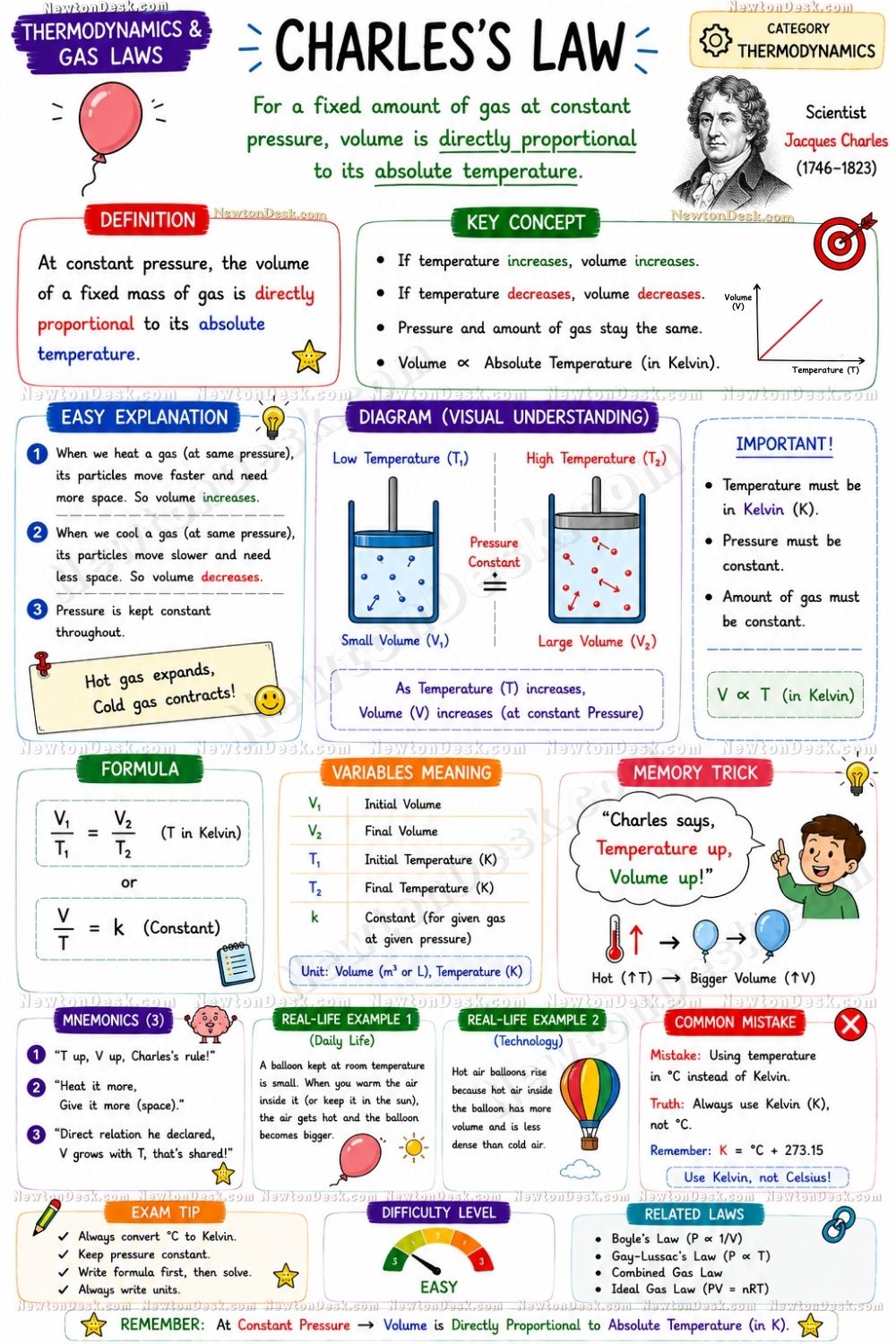
Charles’s Law explains that gas volume increases when temperature increases at constant pressure. Heated gas particles move faster and need more space.
Charles’s Law Formula
Hot air balloons are one of the best examples of Charles’s Law in daily life.
Gay-Lussac’s Law Notes
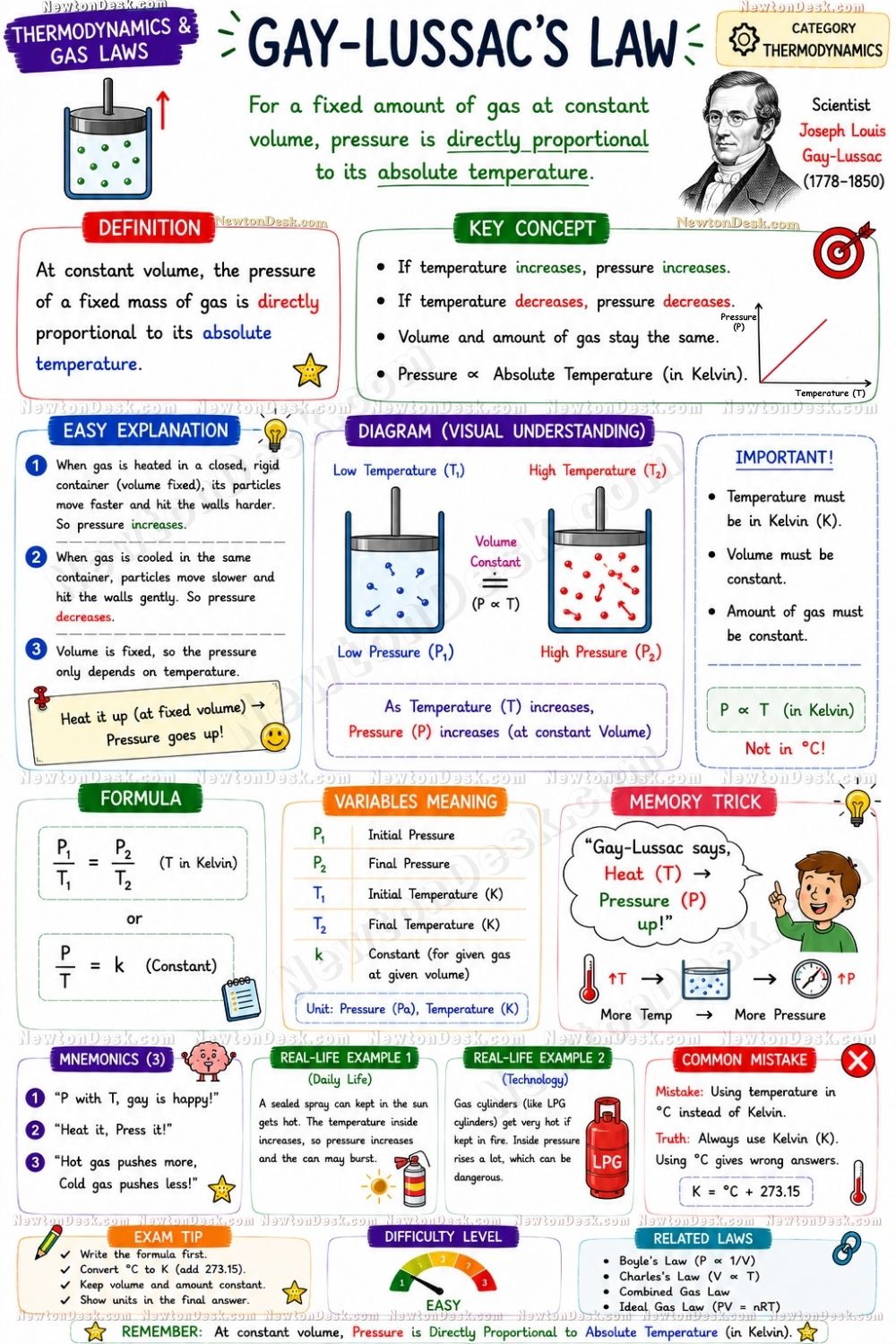
Gay-Lussac’s Law states that pressure increases when temperature increases while volume stays constant. This happens because gas particles hit the container walls harder.
Gay-Lussac’s Law Formula
P1/T1 = P2/T2
Avogadro’s Law Explained
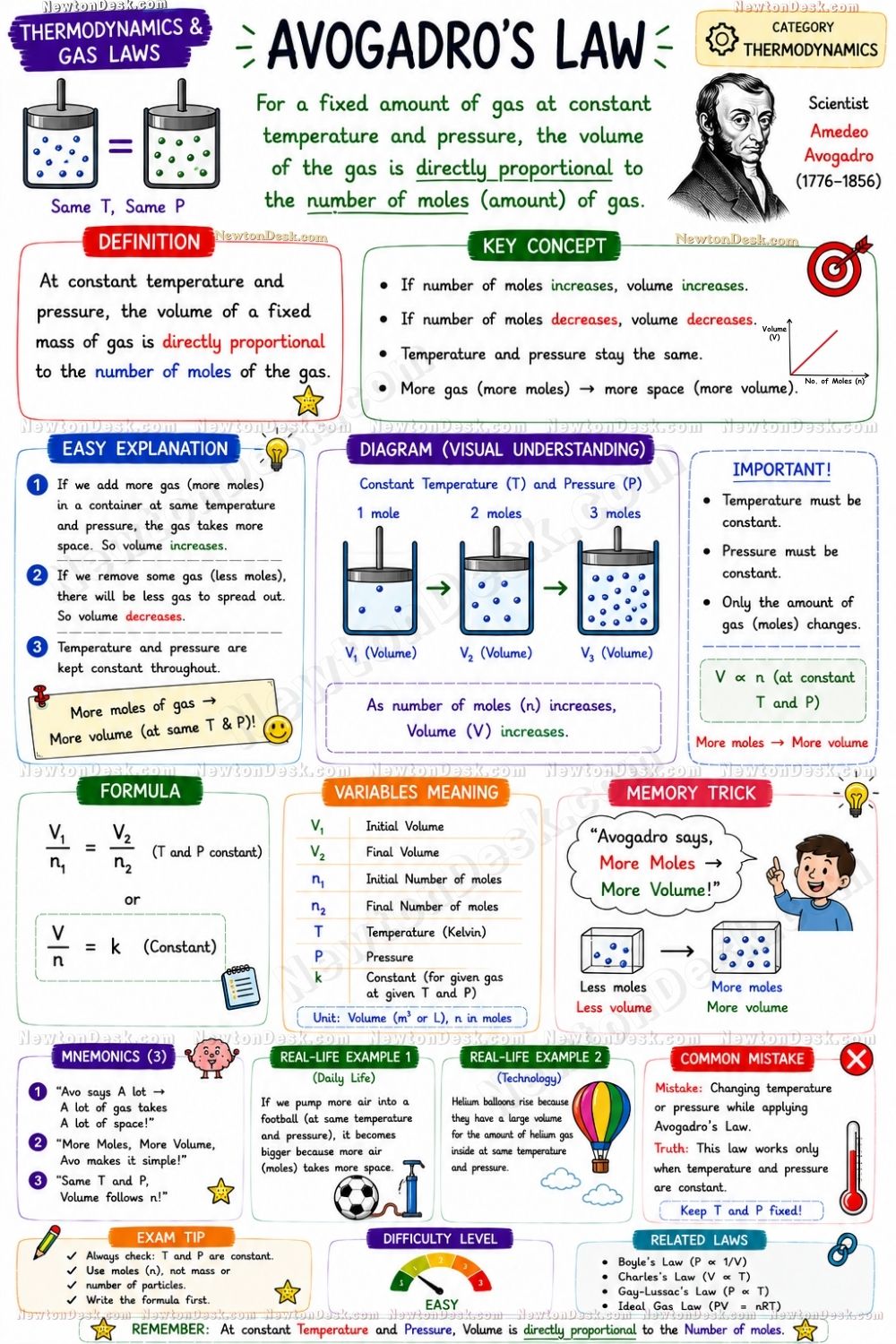
Avogadro’s Law says that gas volume increases when the number of moles increases at constant temperature and pressure. More gas particles need more space.
Avogadro’s Law Formula
V1/n1 = V2/n2
Ideal Gas Law Formula and Notes
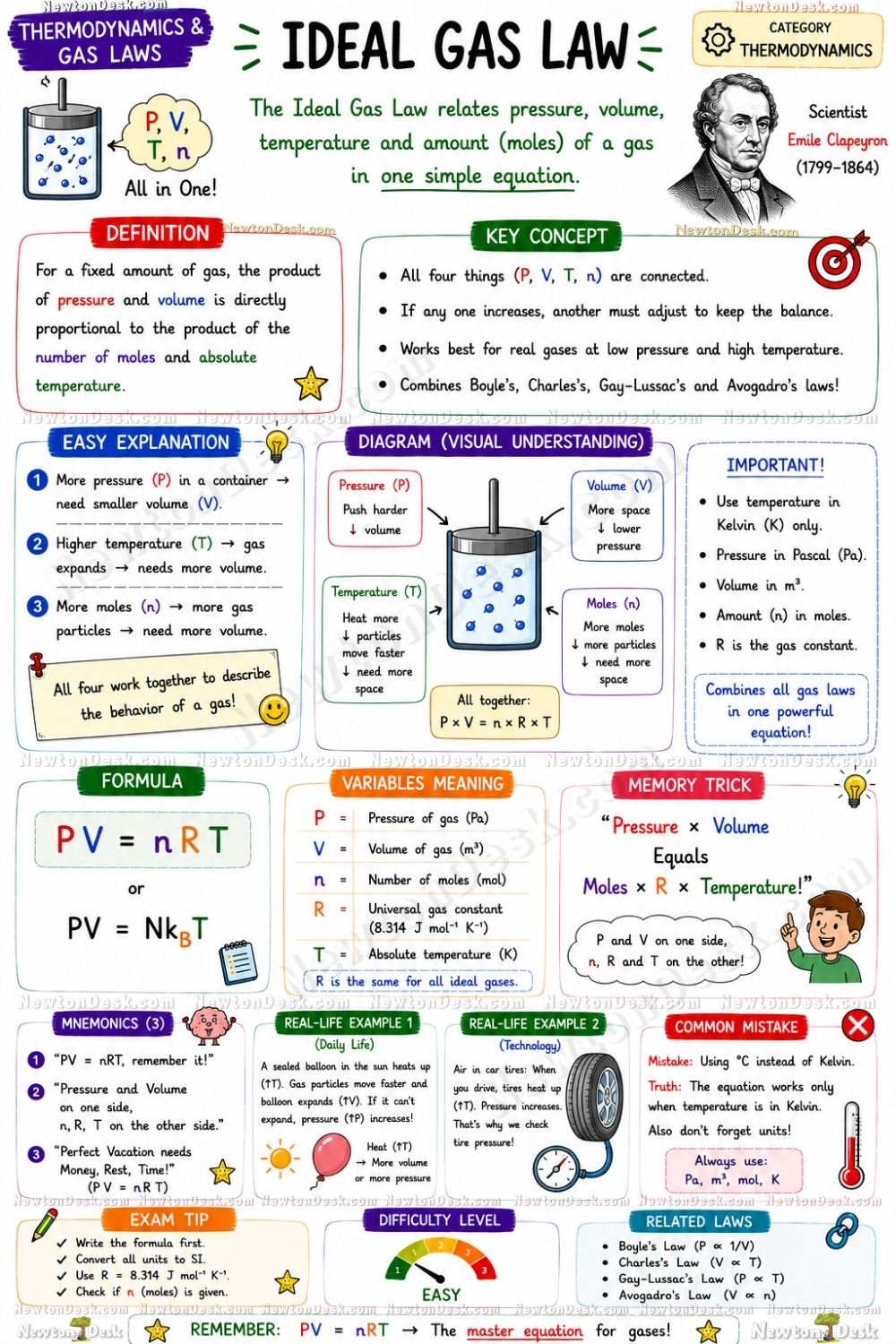
The Ideal Gas Law combines all major gas laws into one equation. It connects pressure, volume, temperature, and amount of gas together.
Ideal Gas Law Equation
This law is very important in chemistry, thermodynamics, and engineering calculations.
Dalton’s Law of Partial Pressure
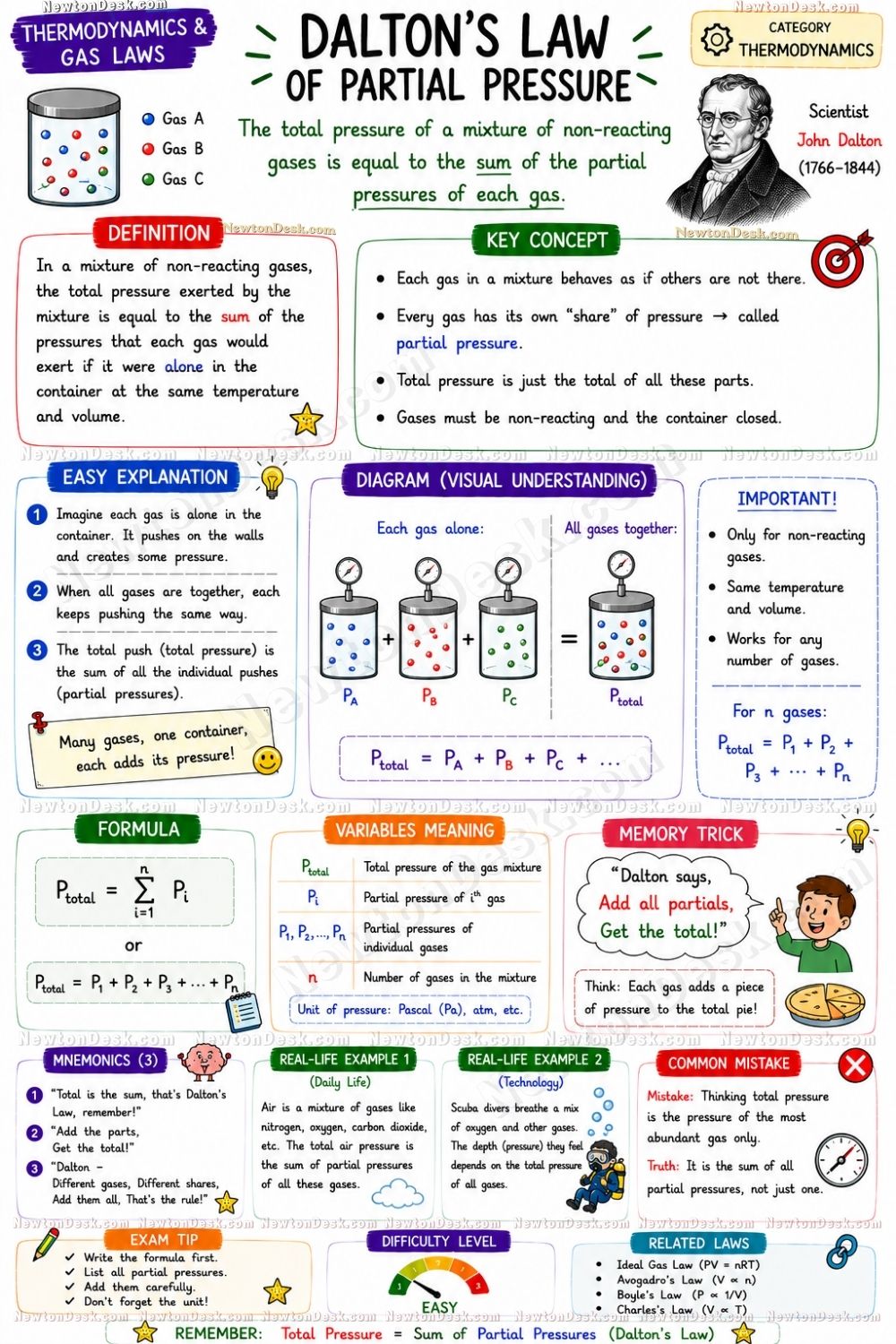
Dalton’s Law explains that the total pressure of mixed gases equals the sum of individual gas pressures. Every gas adds its own pressure inside the container.
Dalton’s Law Formula
P(total) = P1 + P2 + P3 + … + Pn
Why These Gas Laws Matter
These Gas Laws are used in physics, chemistry, medicine, weather science, engineering, and many modern technologies. Understanding these laws helps students solve numerical problems and understand real-world systems more easily.
Final Revision Tips for Students
– Always use Kelvin temperature in gas law formulas
– Learn the relation between pressure, volume, and temperature carefully
– Practice formulas regularly
– Use diagrams and memory tricks for fast revision
– Focus on real-life examples to understand concepts faster
Conclusion
These easy Gas Laws Study Notes help beginners understand thermodynamics step-by-step using simple language and visual learning. From Boyle’s Law to the Ideal Gas Law, every topic becomes easier with formulas, examples, and diagrams designed for quick revision and better understanding.