Newton’s Laws of Motion are some of the most important concepts in Physics and Newtonian Mechanics. These laws explain how objects move, why they stop, and how forces affect motion. Many students find mechanics difficult because formulas and definitions look confusing. But when explained with simple examples, these laws become easy and interesting.
This guide uses visual infographic explanations to help students learn faster. You will understand inertia, force, acceleration, and action-reaction forces using easy language and real-life examples.
CONTENT INDEX
What is Newtonian Mechanics?
Newtonian Mechanics is the branch of physics that studies motion, force, and energy. Sir Isaac Newton introduced three important laws that explain how objects behave in everyday life. These laws are used in school science, engineering, vehicles, sports, rockets, and many real-world situations.
Newton’s First Law of Motion
The First Law of Motion is also called the Law of Inertia. It says that an object at rest stays at rest, and an object in motion continues moving unless an external force changes it.
Simple examples include:
– A parked car stays still until someone pushes it.
– Passengers move forward when a bus stops suddenly.
– Seat belts protect people because of inertia.
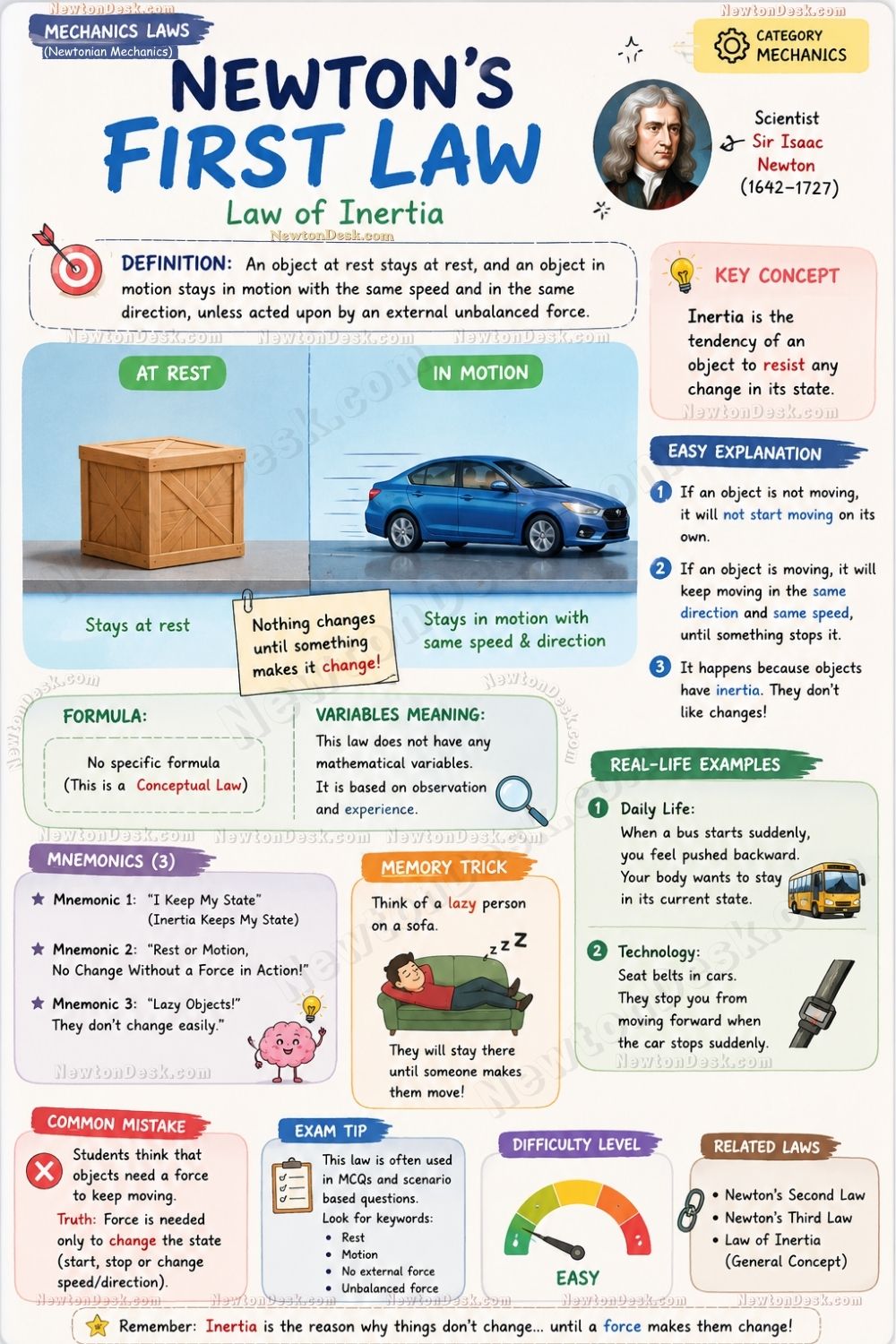
Easy Understanding of Inertia
Inertia means resistance to change. Objects do not naturally want to change their state. Heavy objects usually have more inertia than light objects. This is why moving a heavy box is harder than moving a small bag.
Newton’s Second Law of Motion
The Second Law of Motion explains how force affects acceleration. The formula is:
F=ma
This means:
– More force creates more acceleration.
– More mass creates less acceleration.
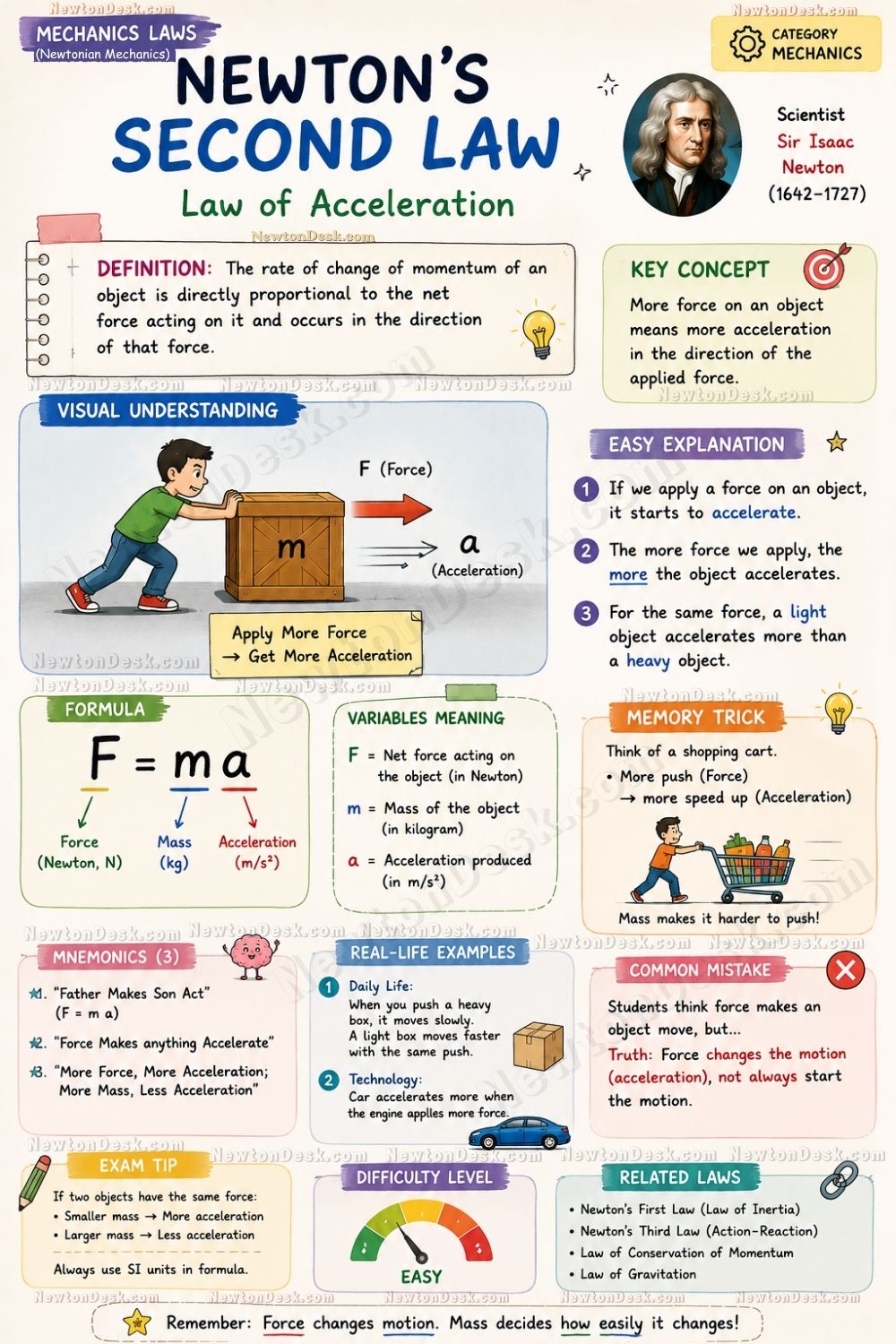
Real-Life Examples of Force and Acceleration
When you push an empty shopping cart, it moves faster because it has less mass. A loaded cart moves slower because it is heavier. Cars accelerate faster when engines apply more force.
Students often remember this law easily using the formula F = ma and practical examples.
Newton’s Third Law of Motion
The Third Law of Motion says that every action has an equal and opposite reaction. Forces always work in pairs.
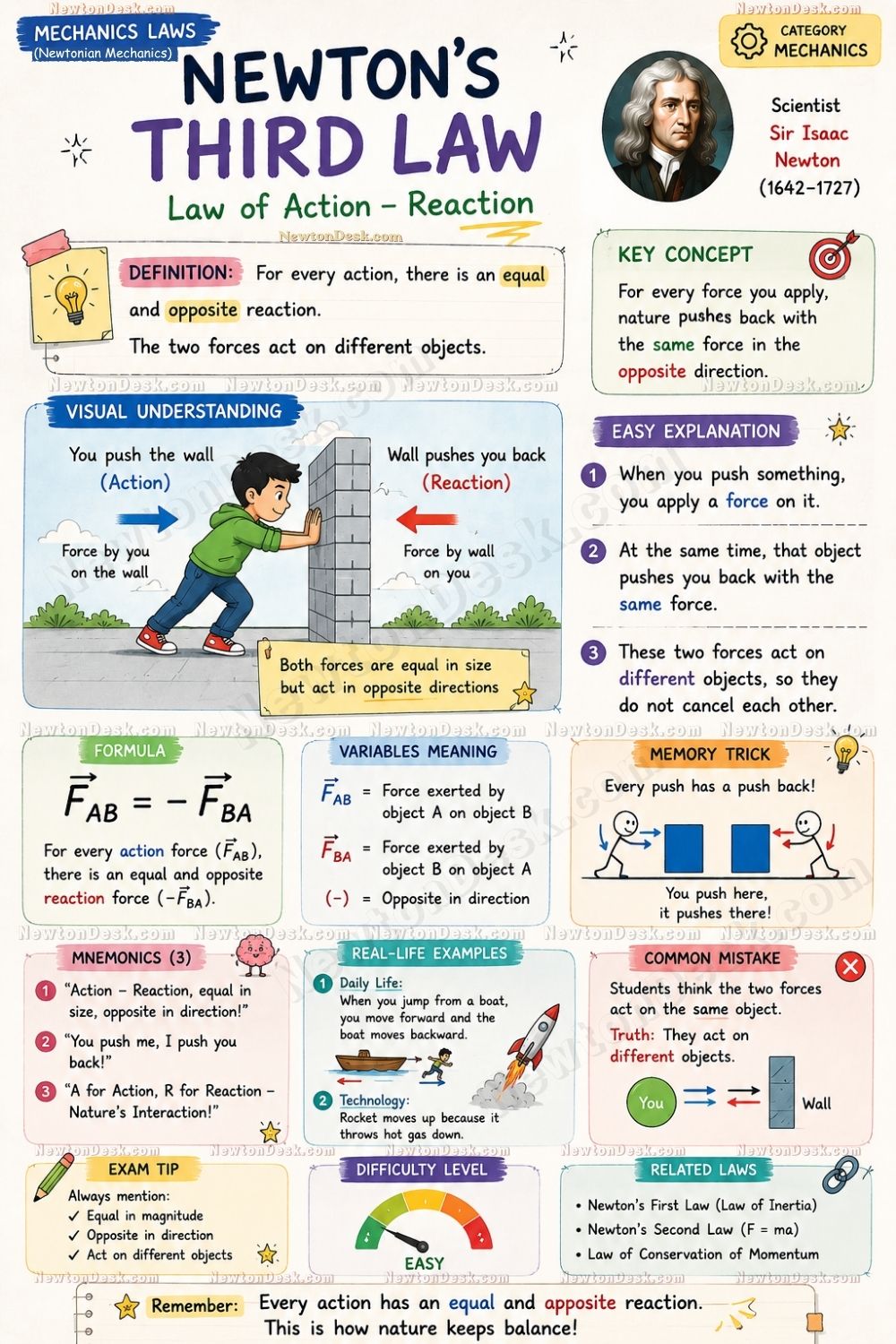
Action and Reaction in Daily Life
When you push a wall, the wall pushes back on you. Rockets move upward because gases move downward. Swimmers push water backward to move forward.
This law helps students understand balance, movement, and force interaction in the real world.
Why Students Should Learn Newton’s Laws
Learning Newton’s Laws of Motion helps students build a strong base in physics and science. These laws appear in:
– School exams
– Competitive exams
– Engineering studies
– Daily life understanding
– Motion and mechanics topics
The infographic method makes learning easier because visuals improve memory and understanding.
Final Summary
Newton’s Laws of Motion explain how the world moves around us. From moving cars to rockets and sports, these laws are everywhere. By learning the concepts of inertia, force, acceleration, and action-reaction, students can understand mechanics in a much easier way.
Use the infographic visuals regularly for revision and quick learning. Simple learning methods help students remember science concepts for a longer time.